

The traditional goal of web design was straightforward: create an experience that keeps human visitors engaged, guides them toward a desired action, and loads fast enough that they don't leave before the page finishes rendering.That goal hasn't changed. What has changed is the additional layer of ma...
Don't Take the Bait: How Credential Stealing Works
Information Technologies | David Steele | Monday, August 17, 2026
Overview
Credential stealing happens when attackers trick people into handing over their usernames and passwords—usually through fake login pages or deceptive emails. Most victims don't realize it happened until the damage is done. Verifying login pages before entering credentials is one of the most effective ways to reduce your risk.
Hackers don't always need to break through walls. Sometimes, they just knock—and people open the door.
Credential stealing is one of the most widespread cybersecurity threats facing businesses today, and the tactics behind it are surprisingly simple. Attackers don't need sophisticated tools. They need a convincing email, a fake login page, and a moment of distraction. That's often enough.

What Is Credential Stealing?
Credential stealing is the act of tricking someone into revealing their login information—usernames, passwords, or both. Once an attacker has those credentials, they can access email accounts, financial systems, internal business tools, and more.
The target isn't always an executive or IT administrator. Anyone with a login is a potential entry point.
How Do Attackers Trick People Into Handing Over Their Credentials?

The most common method is phishing—an email that looks like it comes from a trusted source (your bank, Microsoft, a coworker) but is actually designed to redirect you to a fake site.
Other common tactics include:
Fake login pages that mirror real ones almost perfectly
SMS phishing (smishing), where a text message prompts you to "verify your account"
Malware that records keystrokes as you type your password
Man-in-the-middle attacks, where traffic is intercepted between you and a legitimate site
What makes these tactics effective isn't technical complexity—it's psychology. Attackers create urgency ("Your account will be locked in 24 hours"), impersonate authority figures, and replicate familiar branding with alarming accuracy.
Why Most Victims Don't Know It Happened
This is what makes credential theft particularly dangerous. There's no dramatic system crash. No obvious sign that anything went wrong. You type your password, land on an error page or a "thank you" screen and move on with your day.
Meanwhile, an attacker now holds your credentials.
According to the Verizon 2023 Data Breach Investigations Report, credentials are involved in nearly 50% of all data breaches. IBM's Cost of a Data Breach Report 2023 found that breaches involving stolen credentials take an average of 328 days to identify and contain—nearly a year of exposure before anyone notices.
By the time an organization detects the intrusion, significant damage may already have occurred.
How to Protect Your Credentials
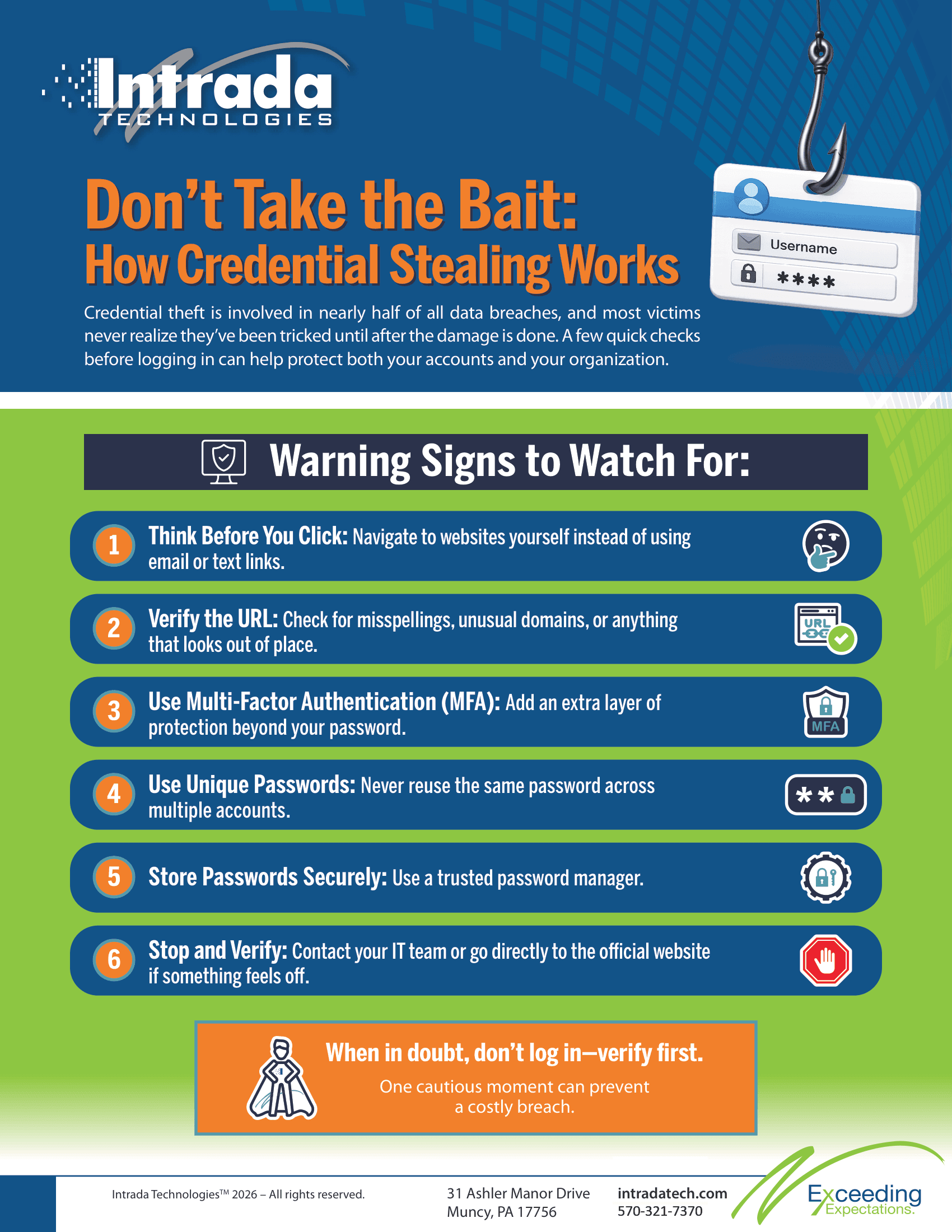
No single step eliminates all risk, but these practices meaningfully reduce your exposure:
Enable
Multi-Factor Authentication MFA MFA Use a password manager to generate and store unique passwords for each account.
Never reuse passwords across multiple platforms.
Pause before clicking links in emails—especially those creating urgency or requesting login.
Type URLs directly into your browser rather than clicking links in messages.
How to Spot a Fake Login Site
Before entering any credentials, take 10 seconds to check:
The URL — Does it exactly match the official domain? Look for subtle misspellings (e.g., "rn" instead of "m", extra hyphens, or different extensions like .net instead of .com).
The padlock icon — HTTPS is standard, but a padlock does not guarantee a site is legitimate. Fake sites use HTTPS too.
The page design — Low-resolution logos, odd fonts, or misaligned elements can signal a forgery.
Unexpected redirects — If you clicked a link and the URL looks different from what you expected, stop and verify.
When in doubt, go directly to the official site by typing the address yourself.
Start With Awareness
Credential theft works because it exploits habits, not ignorance. Most people who fall victim aren't careless—they're busy, and attackers know how to blend in.
Building awareness across your team is the first line of defense. At Intrada Technologies, our Monthly Cyber Awareness service—including this Intrada Tech Talk series—is designed to help your organization stay informed and vigilant, without requiring a technical background.
If you'd like to learn how we can support your team's cybersecurity awareness, reach out to us directly.

ABOUT THE AUTHOR
David Steele is the co-founder of Intrada Technologies, a full-service web development and network management company launched in 2000. David is responsible for developing and managing client and vendor relationships with a focus on delivering quality service. In addition, he provides project management oversight on all security, compliancy, strategy, development and network services.
Learn MoreCybercriminals follow the path of least resistance.Rather than attempting to break through firewalls or exploit complex technical weaknesses, attackers often target the people using the systems every day.Email is attractive because it provides a direct line to:EmployeesExecutivesVendorsCustomersA si...